
Odds Converter — Decimal, Fractional, American & Hong Kong
This odds converter turns any betting price between the four most common formats — decimal, American, fractional and Hong Kong — and shows the implied probability at a glance. Free, instant, no signup required.
🔄 Odds Converter
Convert between Decimal, Fractional, American, and Probability
What Is an Odds Converter and Why You’ll Use It More Than You Think
Here’s a situation you’ll recognize if you’ve ever placed more than a handful of bets. You’re scrolling through a tip on Twitter, the guy posts the bet as +165. You hop over to your bookmaker and the same bet is listed as 2.65. Is that the same price? Better? Worse? Most people just guess and move on. That’s where an odds converter earns its keep — punch in the number, get the answer, no mental math required.
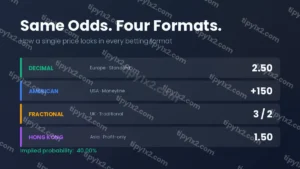
The reason an odds converter matters isn’t just convenience. Different markets default to different formats. American sportsbooks like DraftKings and FanDuel show moneylines (+150, -110), most of Europe runs on decimals (2.50, 1.91), the UK still loves its fractions (3/2, 10/11), and parts of Asia stick with Hong Kong style. If you ever line shop across a few books — which, frankly, you should — you’ll bump into all four sooner or later. For a deeper look at how bookmakers actually set these prices, the Wikipedia article on the mathematics of bookmaking is a solid technical primer.
And it’s not only about reading the number. The implied probability hiding behind every odd is what really matters once you start betting seriously. We’ll get into that in a minute, but first let’s look at the formats themselves. If you want to skip ahead to actionable picks, our daily value bets page uses these exact calculations to flag edges across hundreds of matches.
The Four Main Odds Formats, Plainly Explained
Decimal Odds — The Easy One
Decimal odds are the default across most of the world outside North America. Europe, Australia, Canada, New Zealand — all decimals. The math is dead simple: stake × odd = total payout. So a $20 bet at 2.50 returns $50 if it wins. That’s $30 profit plus your original $20 back. This is the format our odds converter defaults to, mostly because it’s the cleanest to read.
This is why most pro bettors prefer decimal — there’s nothing to interpret, no signs to flip, no fractions to simplify. You see 1.91 and instantly know your $100 bet returns $191. Honestly, if every book in the world switched to decimal tomorrow, betting would be slightly less confusing for everyone.
American Odds — Once You Get Them, You Get Them
American odds (also called moneyline odds) are the standard at every US sportsbook. They come with either a plus or minus sign in front, which throws people off at first.
Positive numbers like +250 tell you how much profit you’d make on a $100 bet. So +250 means risk $100, win $250. Negative numbers like -150 work the other way — that’s how much you need to risk to win $100. -150 means you put up $150 to win $100. Once it clicks, it stays clicked.
The advantage of American odds is that they make the favorite-underdog split incredibly obvious. Minus sign = favorite. Plus sign = underdog. No squinting at decimals to figure out which side is which. Even-money bets sit at exactly +100 (which is the same as 2.00 in decimal, or 1/1 in fractional). The deep guide on American odds at Gambling Sites covers some edge cases like split prices and pick’em lines if you want to go deeper.
Fractional Odds — The British Way
Fractional odds are deeply tied to UK and Irish betting culture, particularly horse racing. You’ll see odds written like 5/2, 13/8, or 4/1. The first number is the profit, the second is the stake required to win it. So 5/2 means stake $2, win $5 profit (plus your $2 back, total return $7).
Fractions sound charming but they’re a pain when the numbers get weird. 9/4? That’s 3.25 in decimal. 11/10? That’s 2.10. 4/7? You’re now doing arithmetic on a Saturday morning before you’ve finished your coffee. This is exactly why an odds converter helps — punch in the fraction and stop trying to do it in your head.
One small wrinkle: bookies in the UK now offer the option to switch to decimals on most sites, so you can avoid fractions entirely if you want. Some people still prefer them out of habit. Tradition dies hard at the racetrack.
Hong Kong Odds — Decimal’s Slim Cousin
Hong Kong odds turn up on a lot of Asian betting sites. They look almost identical to decimals but actually show just the profit portion, not the total payout. A Hong Kong odd of 1.50 equals 2.50 in decimal — your $1 stake wins $1.50 in profit on top of your original dollar.
You’ll see these less often than the other three, but if you bet through any Asian-facing book, you’ll bump into them. Quick conversion to decimal: HK odd + 1 = decimal odd. Or just paste it into the odds converter above and let it do the work.
Implied Probability: Where the Real Edge Hides
Every set of odds, regardless of format, contains a hidden number — the probability the bookmaker thinks an outcome will happen. This is called implied probability, and once you start looking at odds through this lens, betting changes.
The math is one line: 1 ÷ decimal odd × 100 = implied probability percentage. So:
- Odds of 2.00 imply a 50% chance
- Odds of 1.50 imply 66.7%
- Odds of 3.00 imply 33.3%
- Odds of 4.00 imply 25%
- Odds of 10.00 imply 10%
Why does this matter? Because betting profitably long-term comes down to one thing — finding situations where your estimate of the real probability is higher than what the odds imply. If you think a team has a 60% chance to win and the odds price them at 50% (which is 2.00 decimal), that gap is what bettors call value. Or “edge” if you want to sound clever. Our automated value bets scanner does this comparison continuously across hundreds of matches each day.
Most casual bettors never look at implied probability. They see “the odds are 2.50” and place the bet because the price feels nice. Pros do the opposite — they start from their own estimate of how likely something is, then check whether the odds offer a fair price for that view. Without an odds converter doing the implied probability math for you, this gets tedious fast.
The Overround (or Why Probabilities Add Up to More Than 100%)
Here’s something that confuses people the first time they notice it. If you add up the implied probabilities of all outcomes in a market, the total comes to more than 100%. A standard football match might show 105%, 107%, sometimes 110% on smaller books. That extra few percent is called the overround, or the vig, or the juice — different names for the same thing. It’s how bookmakers make money.
Think of it as the house edge. The lower the overround, the better the odds are for you as a bettor. Pinnacle’s own guide on bookmaker margins is one of the most honest breakdowns out there, and worth reading if you want to understand the business side of betting. Pinnacle is famous for offering some of the tightest overrounds in the industry — often around 102-103% on major football leagues. Most mass-market books sit at 105-108%. State-licensed US books frequently push 110% or higher. This is one of those small details that adds up to massive differences over thousands of bets.
How to Use the Odds Converter on This Page
Nothing complicated about using our odds converter. Type any odd into whichever format box you have — decimal, American, fractional or Hong Kong — and the other three update instantly. You’ll also see the implied probability calculated for you below.
No login. No email required. No popups asking you to subscribe to a newsletter for “exclusive picks.” Just a tool that does what it says.
If you bet often, bookmark this page. It’s faster than Googling “convert +130 to decimal” every time you see a US tip on social media, which trust me, you’ll do more often than you expect. Pair it with our Kelly criterion calculator to figure out how much to actually stake once you’ve found a value bet.
Common Odds Conversions You’ll See All the Time
Here’s a cheat sheet of conversions that come up constantly. Even-money, classic football lines, common moneyline prices in NFL and NBA.
| Decimal | American | Fractional | Implied % |
|---|---|---|---|
| 1.20 | -500 | 1/5 | 83.33% |
| 1.33 | -303 | 1/3 | 75.19% |
| 1.50 | -200 | 1/2 | 66.67% |
| 1.67 | -149 | 4/6 | 59.88% |
| 1.80 | -125 | 4/5 | 55.56% |
| 1.91 | -110 | 10/11 | 52.36% |
| 2.00 | +100 | 1/1 | 50.00% |
| 2.10 | +110 | 11/10 | 47.62% |
| 2.50 | +150 | 3/2 | 40.00% |
| 3.00 | +200 | 2/1 | 33.33% |
| 3.50 | +250 | 5/2 | 28.57% |
| 4.00 | +300 | 3/1 | 25.00% |
| 5.00 | +400 | 4/1 | 20.00% |
| 7.00 | +600 | 6/1 | 14.29% |
| 10.00 | +900 | 9/1 | 10.00% |
| 15.00 | +1400 | 14/1 | 6.67% |
The pattern to notice: as odds get longer, small changes in price represent bigger swings in implied probability. The difference between 1.90 and 2.00 is barely 2.5 percentage points of implied chance. The difference between 10.00 and 12.00 is closer to 2 percentage points but in a much smaller pool. This is why “shopping around” matters more on favorites than on longshots — a couple of pips on -110 versus -115 hurts your bottom line over a long sample more than people realize.
A Few Things This Calculator Won’t Do (and Why That’s Fine)
This is an odds converter, not a betting strategy. It tells you what 2.50 is in American or what +200 is in fractional. It tells you the implied probability behind any odd. That’s the job.
It doesn’t pick winners. It doesn’t tell you which sportsbook offers the best line. It doesn’t apply the Kelly criterion to size your bets. Those are different tools for different jobs. If you want value picks, look at our daily value bets page. If you want to size bets properly, try our Kelly calculator. This page just handles the math of odds conversion, cleanly and quickly.
One Last Thing About Reading Odds
Practice makes this faster. The first hundred times you see -110, you’ll think about it. The next thousand, you’ll just know. Same with 1.91 in decimal. After a while, you’ll glance at a price in any format and your brain will automatically translate. Until then — and even after, if you’re being honest — there’s no shame in using an odds converter. It’s faster and it doesn’t make mistakes when you’re tired.
Frequently Asked Questions
What’s the difference between decimal, fractional and American odds?
They’re three different ways of writing the same probability. Decimal (used in Europe) shows your total return per unit staked — 2.50 means a $1 bet pays back $2.50 total. American odds (used in the US) show profit on a $100 bet either as positive numbers like +150 (win $150 on $100) or negative like -200 (risk $200 to win $100). Fractional odds (used in the UK) write the profit and stake as a fraction, so 3/2 means win $3 profit on every $2 staked. All three formats can be converted between each other instantly with the odds converter above.
How do I calculate implied probability from odds?
For decimal odds, divide 1 by the odd and multiply by 100. So an odd of 2.50 gives you 1 ÷ 2.50 = 0.40, or 40% implied probability. For American odds, the formula depends on the sign. For positive odds like +150, it’s 100 ÷ (odd + 100) × 100. For negative odds like -200, it’s |odd| ÷ (|odd| + 100) × 100. Or just paste the number into the odds converter on this page and skip the arithmetic — that’s why it’s there.
Which odds format is the most accurate?
None of them are more or less accurate — they all express the same underlying probability. The format is just a different way of writing the same number. What actually varies between bookmakers isn’t the format but the margin they build in (the overround). Pinnacle typically offers tighter margins than mass-market books regardless of which format they display in. The format is cosmetic; the underlying price is what counts.
Why don’t bookmaker probabilities add up to exactly 100%?
Because bookmakers add a margin (called the overround or vig) to guarantee profit. If all outcomes in a market added up to 100%, the bookmaker would break even long-term. By pricing odds so that implied probabilities sum to maybe 105% or 108%, they create a built-in house edge. The lower the overround, the better the odds are for the bettor. Top books offer 102-104% on major markets; bad books push 110% or more.
Can I use this odds converter for any sport?
Yes. The math behind odds conversion doesn’t care what sport the bet is on. Football, basketball, tennis, horse racing, esports, MMA — odds are odds. Whether you’re converting NFL moneylines, Premier League match prices, or 9/4 on a horse at Cheltenham, the odds converter handles it the same way.
Is using an odds converter cheating?
Not even slightly. It’s just a calculator. Doing the math in your head versus typing it into a tool doesn’t change the bet, the odds, or your edge. Many professional bettors use spreadsheets that automate exactly this kind of conversion across dozens of bookmakers at once. Use whatever helps you make faster, clearer decisions.
